
Introduction
Nobody notices how much they rely on their hearing until it quietly starts slipping away. It rarely happens overnight. It shows up in small ways first. Asking someone to repeat themselves. Missing the punchline of a joke. Turning the volume up a little higher than usual, then a little more, until someone else in the room comments on it.
The harder part is what happens next. Most people do not reach for help. They adapt instead, and adaptation is exhausting. Audiologists have a name for it: listening fatigue. The brain works overtime to fill in what the ears are missing, guessing at half-heard words, reading lips without realizing it, staying on edge throughout every conversation. By the end of a social evening, the effort has compounded into something that feels less like tiredness and more like quiet withdrawal.
The good news is that modern hearing technology has genuinely caught up to the problem. Today’s hearing aids do not just make things louder. The right device, properly fitted, filters sound, adapts to environments, and personalizes the listening experience in ways that feel natural rather than mechanical. The difference between a device that sits forgotten in a drawer and one that changes daily life usually comes down to a handful of specific features.
At RISE Hearing Aid Center, helping people understand those features is part of the work. Here is what matters.
1. Enhanced Sound Quality
Everything starts here.
Sound quality is the foundation on which every other feature rests. Modern hearing aids do not simply amplify sound. They process it digitally, analyzing incoming audio thousands of times per second and adjusting it to match the individual’s hearing profile. The goal is not volume. It is clarity.
Many people find that after their first proper fitting; they rediscover sounds they had quietly stopped expecting to hear. A bird outside the window. The texture in someone’s voice. Small things that had been fading for years without a formal announcement.
A quality device should perform well across all of these:
- Quiet one-on-one conversations
- Busy restaurants and social gatherings
- Open offices and shared workspaces
- Outdoor environments with variable sound
That range is what separates a capable hearing aid from a basic one.
2. Background Noise Reduction
This is the feature people ask about most, and for good reason.
One of the most common frustrations for new hearing aid users is that everything sounds too loud at once. Speech, background noise, and ambient sound all arrive at the same level, and the brain struggles to sort through it. Background noise reduction technology addresses this directly. Advanced devices use digital signal processing to identify and suppress sounds like:
- Traffic and street noise
- Air conditioning and ceiling fans
- Crowd chatter and restaurant ambience
- Electronic hums and background music
All while keeping speech clear and front of mind. Some devices go further with scene recognition, automatically detecting the environment and adjusting settings without the user needing to do a thing. The device reads the room. Literally. For anyone who struggles in group settings or noisy spaces, this feature is non-negotiable.
3. Wireless Bluetooth Connectivity
Hearing aids have become genuinely smart devices.
Bluetooth connectivity allows them to pair directly with smartphones, televisions, and tablets, streaming audio straight into both ears with genuine clarity. Phone calls, music, video calls, and podcasts all come through cleanly, without the interference that used to make phone conversations so difficult.
No more asking people to repeat themselves mid-call. No more turning the television up to a level that bothers everyone else in the room.
Most Bluetooth-enabled hearing aids also connect to a companion app, giving users control over:
- Volume and program settings
- Battery life monitoring
- Environment-specific adjustments
- Remote support from their audiologist
The reality is that this kind of control simply did not exist a few years ago. For many users, the app alone changes how they experience the device.
4. Feedback Reduction
Why does my hearing aid whistle? It is one of the most searched questions about hearing aids, and it points to a genuinely common frustration that puts many people off wearing their device consistently.
Feedback, that high-pitched squeal, occurs when amplified sound escapes the ear canal and gets picked back up by the hearing aid’s microphone. Think of it this way: the device hears itself, amplifies what it hears, and the loop creates the whistle. Common triggers include:
- A hand or object passing close to the ear
- An imperfect physical fit
- Sudden spikes in surrounding sound levels
Modern feedback cancellation systems catch the warning signs before the squeal becomes audible and neutralize it in real time. A well-fitted device with strong feedback reduction should almost never whistle during normal use.
This matters most for people who are physically active, frequently on the phone, or simply in close contact with others.
5. Directional Microphones
Consider a conversation at a busy coffee shop. Sounds arriving from every angle, including from behind and beside you.
Without directional microphone technology, a hearing aid amplifies everything equally. The person sitting across the table sounds no clearer than the espresso machine behind you. Directional microphones fix this by focusing on sound from a specific direction, typically straight ahead, while reducing pickup from the sides and rear.
Higher-end devices offer adaptive directionality, where the microphone pattern shifts automatically to follow the dominant speech signal. If someone speaks to you from the side, the device adjusts. It tracks the conversation, not the noise.
For anyone who finds group settings or social environments challenging, this is one of the most meaningful hearing aid features to look for.
6. Rechargeable Batteries
This one sounds like a small detail. It is not.
Traditional hearing aids run on disposable batteries that need replacing every few days. For anyone with reduced dexterity, the process can be genuinely difficult. Rechargeable hearing aids remove that friction entirely. The devices go into a charging case overnight and are fully powered by morning.
The benefits go beyond convenience:
- No fiddly battery replacements every few days
- Lower long-term cost with no ongoing battery spend
- Better for the environment
- Simpler daily routine, especially for older users
For anyone who values a low-maintenance approach to their hearing care, rechargeable devices make a consistent, daily difference.
7. Synchronization Between Both Ears
Most people with hearing loss wear devices in both ears. The question is how well those two devices communicate with each other.
Modern hearing aids sync wirelessly, adjusting in tandem. Volume changes on one device mirror automatically on the other. If one microphone detects a shift in the environment, both devices respond together.
The result is a more natural, balanced experience with two clear advantages:
- Reduced listening fatigue, because the brain receives consistent input from both sides
- Better spatial awareness, so users can sense more accurately where sounds are coming from
At the more advanced level, synchronized devices can perform binaural beamforming, where both ears work together to create a focused listening zone. It is one of the more impressive capabilities in current hearing technology, and for people who struggled for years to follow group conversations, the difference can feel significant.
8. Custom Fitting
No two ears are the same. And no two hearing profiles are the identical either.
Custom fitting addresses both dimensions. On the physical side, ear molds can be made to match the exact contours of an individual’s ear canal, improving comfort, reducing feedback, and delivering cleaner sound. On the audiological side, a qualified practitioner calibrates the device based on a detailed hearing assessment, adjusting amplification at specific sound frequencies to match precisely where each person’s hearing is stronger or weaker.
Custom fitting covers two things most people do not initially think about:
· Physical fit: Ear molds shaped to the individual’s ear canal for comfort, stability, and better sound delivery
· Audiological programming: Frequency-specific calibration based on a thorough hearing test, not a general setting
Buying a hearing aid without professional fitting is a bit like ordering prescription glasses based on a rough guess at your eyesight. It might help somewhat. It is unlikely to help enough.
At RISE Hearing Aid Center, every fitting begins with a thorough hearing assessment and ends only when the device is genuinely working for the person wearing it.
What Influences the Price of Hearing Aids?
It is a fair question and one that comes up in almost every initial consultation. Hearing aid prices vary considerably and understanding why helps people make smarter decisions.
Advanced Features and Technology
The more sophisticated the processing technology, the higher the cost tends to be. Premium devices with adaptive directionality, advanced noise reduction, Bluetooth connectivity, and AI-powered scene recognition carry a higher price point than basic amplification devices. The investment often reflects meaningfully better performance in complex listening environments.
Brand
Established hearing aid manufacturers invest heavily in research and development, and that investment is reflected in their pricing. However, brand name alone does not guarantee the best outcome. The most important factor is always how well a device is matched to the individual user’s needs.
Warranty and Service
Hearing aids are precision instruments that require ongoing care. Many price packages include multi-year warranties, follow-up adjustment appointments, and repair services. For most users, that ongoing professional support is what transforms a good device into one that performs, year after year.
Ready to Hear Better?
Choosing a hearing aid is not about finding the most feature-rich device on the market. It is about finding the right combination of features for the life a person lives, whether that means quiet evenings at home, demanding work environments, or an active social calendar.
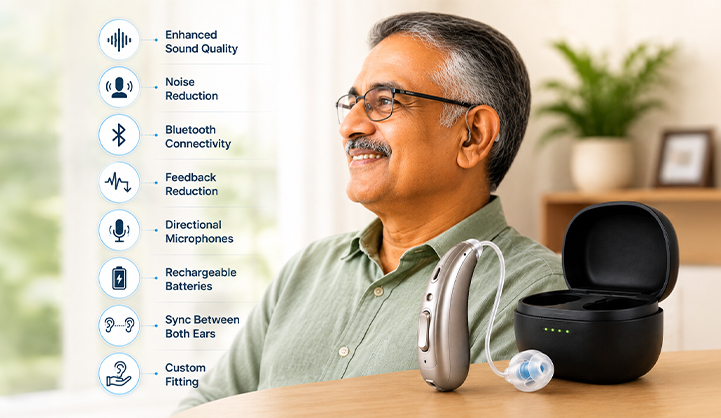
The eight features covered here address the most common real-world challenges that people with hearing loss face daily. Sound quality, noise reduction, Bluetooth connectivity, feedback management, directional microphones, rechargeable batteries, binaural synchronization, and custom fitting are not marketing checkboxes. They are the reasons a properly fitted hearing aid can feel, for many people, genuinely transformative.
If a hearing assessment has been on the list for a while, RISE Hearing Aid Center is a straightforward next step. The process starts with a thorough evaluation and ends with a device that fits the person, not just the ear.