
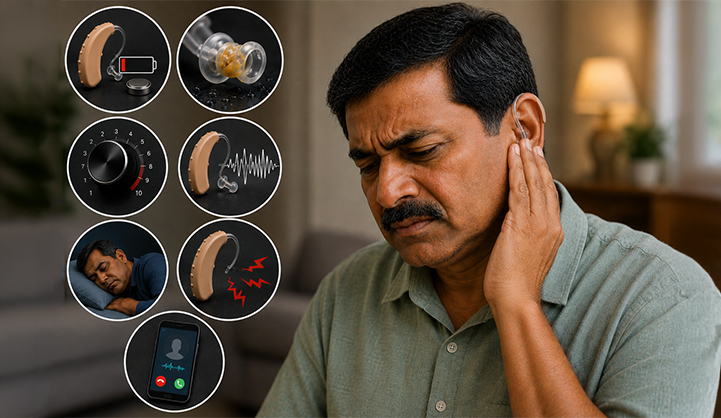
Living with hearing loss is one thing. But living with a hearing aid that keeps acting up? That is a different kind of frustration altogether.
Hearing aids are remarkable pieces of technology. They restore conversations, bring music back to life and help people feel connected again. But they are also small, complex devices that sit in one of the most demanding environments possible, right inside the human ear. So yes, problems of hearing aid users are real, and they are more common than most people realise.
The good news is that most issues are fixable, often without a clinic visit. Here is an honest look at seven problems that hearing aid users frequently encounter, along with what can be done.
7 Major Problems Hearing Aid users face
These are some of the most common problems of hearing aid users, especially during daily use.
1. Low Battery Life: The Most Inconvenient Interruption
Few things are as disruptive as a hearing aid dying mid-conversation. Many users report that battery life feels shorter than expected, especially with older battery types. The truth is, factors like streaming audio, cold weather, and even altitude can drain batteries faster than usual. Zinc-air batteries, the most common type in hearing aids, start losing charge the moment the protective tab is removed.
A few habits help significantly: turning off the device when not in use, opening the battery door overnight, and always carrying a spare set. For those tired of this cycle altogether, rechargeable hearing aids have become an increasingly reliable option worth exploring.
2. Moisture and Earwax Buildup: The Silent Saboteurs
This is the number one cause of hearing aid malfunction worldwide. Sweat, humidity, earwax, and even the body’s natural oils work their way into the microphone, receiver, and tubing over time. The damage is rarely sudden. It creeps in quietly and users often notice it only when sound quality starts to feel off.
A few preventive steps make a real difference:
- Wipe down the device each night with a soft, dry cloth.
- Use a hearing aid dehumidifier or drying kit overnight.
- Replace wax filters (the tiny guards near the speaker tip) regularly, typically once a month.
- Avoid wearing hearing aids in the shower, during heavy exercise, or in high-humidity situations.
Some modern devices come with nano-coating protection, which adds a layer of water resistance. But even those are not entirely waterproof and routine care still matters.
Beyond physical maintenance, sound control itself can become a challenge.
3. Volume Control Challenges: Finding the Right Balance
Adjusting to the right volume in different environments is something many users struggle with, especially those new to hearing aids. A setting that works perfectly in a quiet room can feel overwhelming at a family gathering and too faint during a walk in traffic.
Manual volume wheels can be finicky and not every user finds the buttons intuitive. Fortunately, most modern digital hearing aids can be adjusted through a companion smartphone app, which gives far more control than older analogue models ever offered.
If the volume still feels inconsistent or difficult to manage, the issue may not be the controls at all. It could signal that the hearing aid’s programming needs to be updated to better match the user’s actual hearing profile. That is a conversation worth having with an audiologist.
4. Weak or Unclear Sound: When Clarity Disappears
A hearing aid that produces thin, muffled, or generally weak sound is not doing its job. This is one of the more common complaints and it usually comes down to one of a few causes.
Earwax blocking the receiver is the first thing to check. A clogged wax filter is often the culprit and replacing it takes less than a minute. A damaged or discoloured ear dome, the soft tip that sits in the ear canal, can also affect sound quality noticeably. If the dome appears yellowed, stiff, or warped, it is time to replace it.
Beyond that, weak sound can sometimes indicate that the hearing aid settings are no longer calibrated to the user’s current hearing levels. Hearing does change gradually over time, and a device programmed two years ago may simply no longer be keeping up.
5. Discomfort While Sleeping: A Problem Worth Addressing
Most audiologists recommend removing hearing aids during sleep. Yet some users, particularly those with severe hearing loss or safety concerns, prefer to keep them in. This creates real issues: physical discomfort from the device pressing against a pillow, feedback noise triggered by contact with bedding and accelerated wear on the device itself.
For anyone in this situation, smaller in-the-canal (ITC) or invisible-in-canal (IIC) styles tend to be more sleep-friendly due to their low profile. Some users also find that a dedicated body pillow with a cut-out ear section reduces pressure significantly.
If the discomfort is ongoing regardless of device style, it may point to an incorrect fit. Hearing aids should feel unobtrusive, not something you are constantly aware of. A professional fitting review often resolves this.
6. Buzzing or Whistling Sound: The Feedback Loop Nobody Wants
That high-pitched whistle or buzzing sound is called acoustic feedback and it happens when amplified sound leaks out of the ear canal and gets picked up by the microphone again. It is a loop and it is deeply annoying for both the user and people nearby.
Common causes include:
- The hearing aid sitting loosely in the ear.
- Volume set too high for the current fit.
- A build-up of earwax in the ear canal, which changes how sound moves.
- A damaged or ill-fitting ear mould.
Repositioning the device often helps immediately. If the whistling is frequent or happens even at low volumes, the ear mould may need to be remade or the device may need professional recalibration. Feedback management technology in newer hearing aids has improved dramatically, so persistent whistling in an older device may also be a sign that an upgrade is overdue.
7. Difficulty With Phone Calls: A Frustration Many Recognise
Phone calls remain one of the trickier situations for hearing aid users. Holding a phone to the ear can inadvertently trigger feedback. Bluetooth connectivity sometimes drops. And the audio quality of a phone call is never as rich as in-person conversation, making it harder for the hearing aid to do its job well.
Many modern hearing aids support direct streaming from smartphones, which bypasses the microphone entirely and sends audio straight to the device. This is a significant improvement. For those with older models, telecoil (T-coil) settings, which are available in many devices, can improve call clarity by reducing background noise interference.
If Bluetooth pairing is the issue, keeping both the phone’s software and the hearing aid’s firmware up to date often resolves connection problems. When it does not, a quick check with the clinic’s team can rule out deeper technical issues.
Can Hearing Aids Cause Sinus Problems?
This question comes up more often than expected and it is worth addressing clearly.
Hearing aids do not directly cause sinus problems. The sinuses and the ear canal are connected through the Eustachian tube, so pressure or discomfort in one area can sometimes be felt in the other. If a hearing aid fits poorly and puts pressure on the ear canal, some users report a sensation of fullness or mild pressure that can feel sinus related.
Moisture trapped in the ear from prolonged hearing aid use can also create an environment that, for individuals already prone to ear or sinus issues, may aggravate existing conditions.
The solution is straightforward: ensure the device fits correctly, use a drying kit regularly, and speak with a healthcare provider if sinus discomfort persists alongside hearing aid use.
When to Seek Professional Help for Hearing Aid Problems?
Many of the issues above can be managed at home with good habits and basic troubleshooting. But some situations genuinely warrant a professional evaluation.
It is time to visit a hearing care centre when:
- Problems persist even after basic troubleshooting.
- There is a sudden and noticeable decline in hearing ability.
- The device has been physically dropped or exposed to water.
- Feedback or whistling cannot be resolved by repositioning or cleaning.
- The ear mould feels uncomfortable after several weeks of use.
Early attention to these issues prevents small problems from becoming expensive ones.
Conclusion – Visit Us Today
Experiencing any of these problems does not mean something is permanently wrong. It usually means the device needs a little attention and so do you.
At RISE Hearing Aid Centre, experienced audiologists work closely with each individual because hearing loss is not one-size-fits-all and neither are the solutions. Whether it is a routine servicing, a fitting adjustment, or a full consultation about upgrading to a newer model, there is always a practical next step.
Come in and let the team take a look. Better hearing is closer than it might feel right now.