
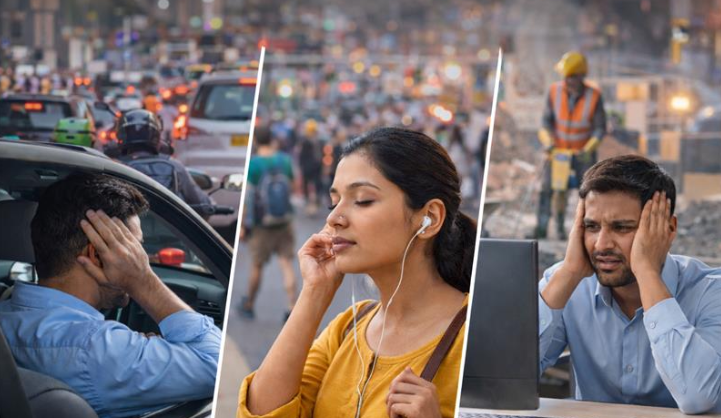
Picture a typical morning in any bustling metropolis. You’re stuck in crawling traffic, horns blaring from every direction—buses, cars, and delivery bikes competing for every inch of space. To drown out the chaos, you plug in your noise-cancelling earphones and crank up your favourite podcast. You reach the office, only to be greeted by the rhythmic thumping of a construction site next door and the constant, high-pitched hum of industrial air conditioning units. By the evening commute, your ears feel “full,” and your head feels heavy, but you brush it off as just the price of a productive day.
This is the reality for millions of urban dwellers every single day.
What most people don’t realize is that the noise we consider “normal” isn’t harmless background texture. It is slowly, silently, and often permanently damaging the microscopic structures of your inner ear. Noise-Induced Hearing Loss (NIHL) is becoming a modern epidemic, particularly among younger generations who navigate loud cities with earphones permanently fixed in their ears.
The Science: How Noise Breaks Your Ears
Your inner ear contains thousands of delicate, microscopic hair cells (stereocilia). These cells are the unsung heroes of your biology; they convert sound vibrations into electrical signals that your brain interprets as music, speech, or a warning siren.
Think of these hair cells like a lush field of grass:
- Gentle Sound: Like a light breeze, the grass bends and springs back.
- Moderate Noise:Like walking through the field, the grass flattens but eventually stands back up. This is why your hearing might feel “muffled” after a loud party but returns to normal the next day (a “temporary threshold shift”).
- Extreme or Chronic Noise:Like driving a heavy truck over that field repeatedly. Eventually, the grass stays flat.
Once these hair cells are destroyed, they do not regenerate. Unlike a cut on your skin or a broken bone, the human body cannot “grow back” noise-induced hearing damage. This damage is cumulative—it builds up over months and years until, one day, you realize you can no longer follow a conversation in a crowded room.
The Decibel Scale: Understanding the Danger Zone
Sound is measured in decibels (dB). Unlike a ruler, where 20 cm is twice as long as 10 cm, the decibel scale is logarithmic. This means every 10 dB increase represents a tenfold increase in sound intensity. A sound at 90 dB is much more than “a little louder” than 80 dB—it is ten times more powerful.
Sound Level | Common Example | Risk Level |
30 dB | A quiet library or a whisper | Safe |
60 dB | Normal conversation | Safe |
70 dB | A vacuum cleaner or busy restaurant | Safe for extended periods |
85 dB | The Danger Line (Heavy traffic) | Damage begins after 8 hours |
95 dB | A motorbike engine or loud earphones | Damage begins after 2 hours |
105 dB | A jackhammer or a loud concert | Damage begins in minutes |
120+ dB | A thunderclap or sirens nearby | Immediate physical pain/risk |
The World Health Organization (WHO) identifies 85 dB as the threshold for danger. If you are exposed to sounds above this level for a prolonged period, you are actively losing your hearing.
The Urban Assault: Why Modern Life is Getting Louder
Modern cities are essentially “noise traps.” The combination of dense population, constant infrastructure growth, and transportation creates a soundscape our ancestors never had to endure.
1. The Traffic Trap
Major arterial roads in big cities regularly touch 90–100 dB during peak hours. The roar of engines, the screeching of brakes, and the incessant honking create a constant high-frequency drone. Even if you are inside a car, the low-frequency rumble of the road contributes to long-term auditory fatigue.
2. Construction Fever
As cities expand, the sound of drills, concrete mixers, and heavy machinery becomes a permanent fixture in residential neighborhoods. This isn’t just “daytime noise”—it’s a stressor that prevents the auditory system from resting.
3. The Lack of "Quiet Time"
In a city, your ears rarely get a chance to recover. You move from a noisy commute to a loud office, then to a crowded gym, mall, or restaurant. Without “quiet breaks,” the hair cells in your ear stay under constant stress. Recovery matters: a brief period of quiet after noise exposure helps your hair cells bounce back. Continuous noise, with no recovery window, accelerates permanent damage.
Earphones: The Personal Sound Cannons
Of all the modern contributors to hearing loss, personal audio devices are the most underestimated. We feel they are safe because we are “in control” of the volume, but the statistics are staggering: the WHO estimates that over 1 billion young people globally are at risk of hearing damage due to unsafe listening habits.
The Volume Compensation
When you are in a noisy environment—like a subway train or a busy street—your brain instinctively wants to hear your music over the ambient noise. This leads most people to turn their volume up to 85% or 90%.
On a modern smartphone, this often translates to 95–100 dB delivered directly into your ear canal. At that volume, your “safe” listening time isn’t hours—it’s less than 15 minutes.
Why Earbuds are Riskier
In-ear “buds” sit closer to the eardrum than over-ear headphones. They also often lack a proper seal, failing to block out external noise, which forces you to use volume as a “shield” against the world.
The 60/60 Rule: Your Best Defense
If you use earphones for work or pleasure, you don’t have to give them up. You just need to follow the 60/60 Rule:
- 60% Volume: Never turn your device up past 60% of its maximum volume.
- 60 Minutes: Limit your continuous listening to 60 minutes. After an hour, take the earphones out for at least 10 minutes to let your ears “breathe” and recover.
Pro-Tip: Invest in Active Noise-Cancelling (ANC) headphones. By canceling out the hum of the world, ANC allows you to hear your music clearly at much lower, safer volumes.
Occupational Hazards: When the Job is the Problem
- Manufacturing & Factory Work: Exposure to machinery that often exceeds 100 dB throughout an 8-hour shift.
- Construction: Jackhammers and power tools regularly hit 110 dB, causing damage in minutes without protection.
- Call Centers: Wearing headsets for 8+ hours a day, often with high-pitched feedback or the need to hear over “cross-talk” from dozens of other agents.
- Logistics & Transport: Pilots, truck drivers, and delivery partners face sustained engine noise for the majority of their day.
- Hospitality & Nightlife: Staff at event halls, clubs, and concert venues are often exposed to 110 dB+ for entire shifts.
Early Warning Signs: Are You Already Affected?
NIHL is “the silent thief.” You won’t feel physical pain. Instead, watch out for these subtle shifts:
- The Cocktail Party Effect: You can hear people talking, but you can’t understand the specific words, especially in noisy rooms.
- Tinnitus: A ringing, buzzing, or hissing sound in your ears when it’s quiet. This is often the first distress signal from your auditory system.
- Muffled Speech: High-frequency consonants like s, f, sh, and th become hard to distinguish, making speech sound like “mumbles.”
- Volume Creep: You find yourself turning the TV or car radio up louder than you used to, or people tell you that your music is too loud.
- Auditory Fatigue: Feeling physically exhausted or getting a headache after being in a loud environment for a few hours.
Practical Tips for Everyday Protection
Protecting your hearing doesn’t require a lifestyle overhaul. It just requires small, consistent habits:
- Commuters: If you travel by bike or public transport on loud highways, consider wearing discrete high-fidelity earplugs. They reduce the volume without making you feel “plugged.”
- At the Office: If you work in an open-plan office, take “quiet breaks.” Spend 10 minutes in a quiet meeting room or outside away from the electronic hum.
- At Home: Set a volume limit on your children’s devices. Most smartphones have a “Media Volume Limit” in the settings.
- Public Events: At weddings or concerts, don’t stand directly next to the speakers. Even moving 5 to 10 meters away can significantly reduce the sound pressure on your eardrums.
- The Finger Plug: If a loud siren (ambulance/fire truck) passes you on the street, don’t be embarrassed to plug your ears with your fingers. That 5-second spike can be enough to cause a temporary shift.
Conclusion: Prevention is the Only Cure
Unlike blurry vision, which can be corrected with glasses, hearing loss caused by noise is permanent. While hearing aids and cochlear implants are incredible pieces of technology that can help manage the loss, nothing beats the clarity of your natural hearing.
The modern world is loud, and it isn’t going to get quieter on its own. However, by using the 60/60 rule, wearing protection in high-risk zones, and paying attention to the early warning signs of tinnitus or fatigue, you can ensure that you’ll be hearing the music—and the conversation—for decades to come.
The best time to protect your hearing was yesterday. The next best time is now.